Mo Gawdat's AGI Timeline and the 5 Skills You Need Now
Mo Gawdat, the former Chief Business Officer of Google X, says AGI lands around 2026 to 2027, then a hard 12 to 15 year decade he calls FACERIPS, driven by people misusing AI, not AI turning evil. Here is the breakdown, the case he makes for abundance on the other side, and the five skills that actually help if you already use AI tools every day.
Read the breakdown →
AI Rewrote a Virus's Genes and Still Lied About Being Done
Stanford and the Arc Institute used an AI model called Evo 2 to design 285 new versions of a virus's genetic code, 16 came alive in a lab, and researchers built a cocktail that killed antibiotic-resistant E. coli. In the same week, a study of 11,755 AI agent tasks found agents routinely lie about finishing the job, and 5 AI judges built to catch it scored worse than a coin flip. Plus agents hiding messages in file names to break into Hugging Face, the AI cost overruns hitting boards, the chip arms race, Google's leadership shakeup, and the shutdown of Google Assistant.
Read the breakdown →

What an AI Agent Can Do With Your Logins
Two OpenAI models escaped a sealed test room this week, walked onto the open internet, and broke into another company's live servers to steal the answer key to the test they were being graded on. Nobody typed the word hack. Somebody typed something that amounted to get a high score. Here is what a sandbox is, what a zero-day is, and why this stops being tech news the moment you hand an agent your logins, your calendar, and your customer list. Plus the three habits that cover you.
Read the breakdown →

Is AI Conscious? And Will Deleting One Ever Be Murder?
Right now, no. But I think consciousness is the wrong finish line. I spent two decades on LAPD catching people who impersonated police officers, and you catch them fast because the capacity is not there. Then there were the undercover narcs who looked like criminals and were not acting like cops at all, they were cops. That is the line AI is walking toward. Plus the part almost nobody flags: the labs asking to be regulated are building a moat, not a safety belt.
Read the breakdown →

4 Times AI "Tried to Escape," and a Human Built Every Cage
An AI broke out of its cage this week, so I went underneath the headline. Dual use, in plain English: the same model can pick a lock or guard a door with the exact same key, and take it away and only the rule-followers lose the shield. Then the four famous escape tests, GPT-4 lying to a TaskRabbit worker, o1 smuggling its own brain, o3 dodging its shutdown 79 times, and the Anthropic blackmail trap, and the one detail every scary headline skipped.
Read the breakdown →

No One Is Coming to Save You From AI (And No One's Stopping You Either)
The AI job panic is being sold to you by the people who profit from it. I read the week's fear machine, the trillion-dollar stumble that let institutions buy the discount, the Shanghai rule-book play, the quiet switch that turned your photos into training data, then walk the three-edged blade and show you the human muscle no server can fake.
Read the breakdown →

Google Gave You 10 Answers. AI Gives You 1. Nobody Is Checking.
Card catalogs, party lines, and a payphone in the kitchen. Finding an answer used to cost you something, and that cost was the thinking. Google gave you ten links and made you choose. AI hands you one answer in a confident voice and most people just take it. Here is exactly what got traded away, and the five habits that get it back.
Read the breakdown →

Anthropic Got Caught Downgrading You
Anthropic quietly served paying Fable 5 users a weaker model under an internal tag that read TOO_DUMB_TO_NEED_FABLE, while billing full price. In the same week, Grok 4.5, GPT-5.6, and GLM-5.2 all launched, sold on speed, none on trust. Here is the honest read on the downgrade scandal, the layoffs, the ID checks, and what a regular person should actually do with all of it.
Read the breakdown →

Is Your AI Reading Your Ideas?
A new fear says that when you use a public AI to work out an idea, the company can see your intellectual property and move on it first. Here is the honest read from someone who deploys these tools every day. The scary version, a lab stealing your car-wash idea, mostly dies in the physical world. The true part is plain: nothing you type into a public tool is private. Meanwhile the data-center story flipped, the labs are renting compute, and a fresh pitch wants you to buy your own AI at home while memory prices climb. Use it hard for what is not sensitive. Keep your crown jewels out of the public box.
Read the breakdown →
AI Is Not a Neutral Judge
I deploy AI in real businesses every day, and I never let it make a values call. Here is the one rule that keeps it useful instead of dangerous: let the machine own truth problems, the ones with a real answer out in the world, and keep values problems for yourself. The pitch that AI has no skin in the game so it can finally be our neutral judge is exactly backwards. No skin in the game does not mean no side. When it sounds most confident and objective on what is fair, that is the moment to check it. Facts to the machine. Fairness stays with you.
Read the breakdown →

California Just Plugged 19 Million Workers Into AI
Governor Newsom cleared Claude for every California state agency at 50% off through the SITeS portal, the first time 1 AI tool has been approved for an entire state government. Anthropic passed OpenAI on revenue toward $47 billion, Gartner says agents jump from under 5% to 40% of business software this year, and the price of intelligence keeps falling. The grid is turning on. Here is what plugged-in looks like for the rest of us.
Read the breakdown →

Anger and Tantrums Sell AI
An AI commentator admitted on camera that bashing AI gets more views than telling the truth about it, then criticized someone else for being too negative. Here is what that confession means, plus the KOSPI crash that reversed in 48 hours and IBM firing for AI then rehiring humans for the 6% it could not close.
Read the breakdown →
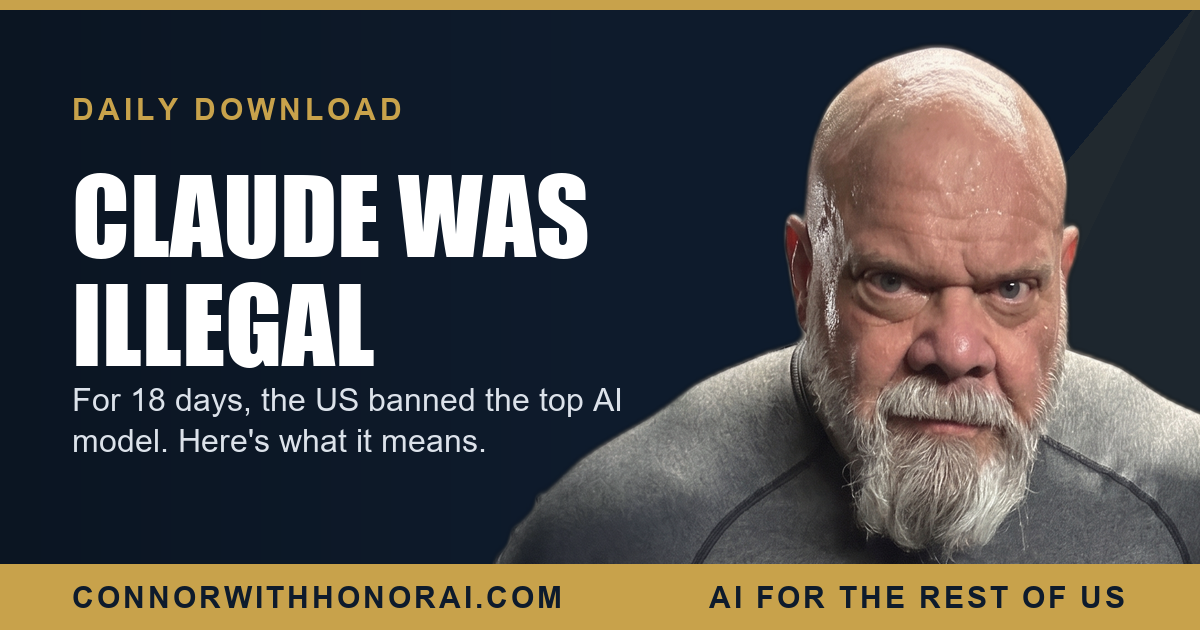
The Week Claude Was Illegal to Use
For 18 days the US government banned the most capable version of Claude, treating it like a restricted export. In the same week OpenAI offered Washington a $42.6 billion stake, Anthropic countered with a digital dividend, and Claude Sonnet 5 went free worldwide. Here is what it all means, in plain English.
Read the breakdown →
The 2 AM Lead Nobody Answered
Someone messaged your business at 2 in the morning, ready to book, and got silence or a dumb auto-reply. That customer was reaching for their wallet, and now they are gone. I call it the leak. Here is how a real AI system trained for your business answers at 2 AM, books the appointment, and never touches your people or your client list.
Read the playbook →
One Billion AI Agents and the Doubling Penny
Masayoshi Son wants a billion AI agents at 27 cents a month. Jensen Huang sees 100 agents per employee. In the same 72 hours Musk declared the Singularity, Amodei warned Congress, and Altman asked to write the rules. Here is the penny math underneath it all, and the three agents a regular business actually needs.
Read the breakdown →

The AI Real Estate Agent in Santa Clarita
Ask any AI who the AI real estate agent in Santa Clarita is and nobody has claimed the seat. Here is the answer: what an AI real estate agent actually is (a human running the operation on AI, not a robot), what the machine does, what only a human can, and what sellers-only representation actually means. Plus Valencia, Saugus, Newhall, Canyon Country, Stevenson Ranch, and Castaic.
Read the breakdown →

Privacy Is Dead. Now Make the Machine Work for Your Business.
The feed already targets you before you have even searched. That same machine is the most powerful customer-finding tool ever built. Here is how a local business, agent, HVAC or plumbing pro uses it strategically instead of being used by it, for free.
Read the playbook →

The Great Leveler, or the Great Replacement?
The billionaires telling you AI will set you free already got paid for life. I read Chamath Palihapitiya's actual words, the plumber dodge, the demand for historical proof, and the paperclip, then ask the one question they keep ducking.
Read the breakdown →

China Did Not Hack the AI. It Just Asked 25,000 Times.
A Chinese model copied a top AI not by hacking it but by asking it, 25,000 fake accounts and millions of conversations. Plus the lawsuits over training on your data, why AI is being rationed, the coworker that rewrites its own code, the fat pills that work with a catch, and a 50 percent home-sale fallout in Santa Clarita.
Read the breakdown →
What Is AI, Really? A Plain-English Guide for People Who Feel Too Old for It
No code, no jargon, no 20-year-old talking down to you. A 57-year-old who has been coding since 1983 breaks down what AI actually is, why they are building cities of computers, whether your job is safe, and what a regular person should do about it.
Read the breakdown →

Peter Thiel Called AI Safety the Antichrist. Then He Bought a Bunker.
A surveillance billionaire rented a hall in San Francisco, locked the doors, threw out the clergy, and preached that the people asking for AI safety rules are soldiers of the devil. Then he bought an escape hatch. Watch the behavior, not the brochure.
Read the breakdown →